The Secret Life of Plants: Unveiling the Mysteries of Time and Gardening
"Exploring Retrocausality, Time Travel, and the Mystical Magic of Gardening"

Ah, summer! The season of warm breezes, vibrant flowers, and the sweet symphony of birds chirping. As the days grow longer, we find ourselves drawn to the garden, spending hours amidst the greenery, nurturing our little patch of paradise. There's something almost magical about watching a seed sprout into a full-blown plant, its leaves unfurling to embrace the sun.
Retrocausality: When the Present Affects the Past
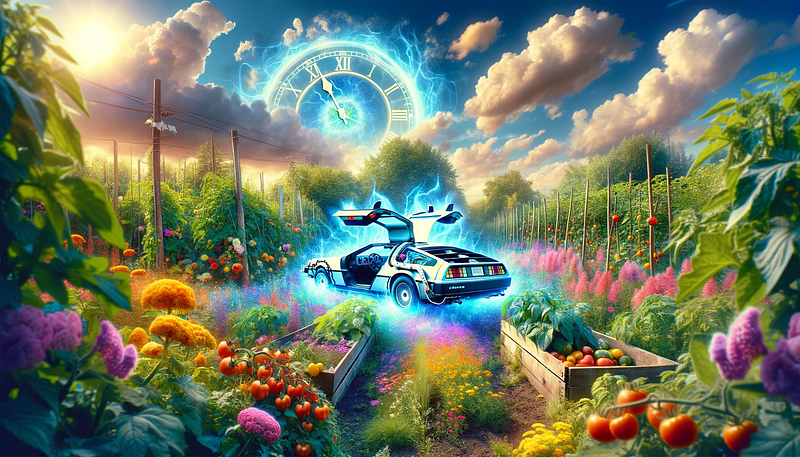
What if the present could influence the past? This concept, known as retrocausality, has been tickling my brain lately. Imagine if the actions we take today could somehow ripple back and alter what has already happened. It's a fascinating and somewhat unsettling idea.
Look, I'm no physicist. So let's not pretend I'm offering some groundbreaking scientific theory here. I'm just a guy who loves to ponder the what-ifs of the universe. I dabble in these ideas more for the philosophical fun of it — I haven't cracked open a quantum physics textbook to really understand the nitty-gritty. If you're looking for cold, hard facts, you'd better dive into some serious study. My musings here are just that — musings.
Retrocausality, or backwards causation, challenges our everyday understanding of time. We usually think of time as a one-way street — past, present, future, in that order. But what if the flow of time doesn't necessarily move in just one direction?
This isn't just science fiction. In quantum mechanics, there's something called the "delayed choice experiment," which suggests that actions performed in the present can influence outcomes in the past. The idea was notably discussed by physicist John Wheeler, who proposed that decisions made now could affect the path taken by a photon in the past. In Wheeler's delayed-choice experiment, a photon is fired at a screen with two slits. If the experimenter chooses to observe the photon's path after it has passed through the slits, it behaves like a particle rather than a wave — suggesting that the act of observation itself can influence behavior, even retroactively.
As I've been reflecting on it, I realize there's no way I can really test this. If the present was affecting the past, we'd never know — because the past would always change in congruence with the present. This idea messes with our heads because it means our history could be constantly shifting without us even knowing it.
The Simulation Hypothesis: Rewriting Reality
Let's consider another wild concept. If we're in a simulation, retrocausality could be part of the system's programming. In a simulated reality, rules can be bent. Who's to say our memories and experiences aren't being rewritten in real-time by some advanced civilization? Whether that's terrifying or exhilarating, I'll leave that up to you.
Back to the Garden
Speaking of the garden, I noticed the roses are blooming early this year. The vibrant reds and pinks add such a lovely touch to the landscape. And the tomatoes — oh, they're coming in beautifully. Nothing beats the taste of a freshly picked tomato, still warm from the sun.
References
- Wheeler's delayed-choice experiment — Wikipedia
- This Quantum Theory Predicts That The Future Might Be Influencing The Past — ScienceAlert
- Quantum mechanics: How the future might influence the past — Phys.org
- Physicists provide support for retrocausal quantum theory — Phys.org